Artificial intelligence is quickly becoming a business investment priority. Companies are adopting AI to automate processes, boost productivity, analyze data, enhance customer experiences, and support decision-making.
However, adoption does not automatically translate into financial returns.
The more important question is not whether a business is using AI, but whether the investment creates measurable value.
AI Adoption Does Not Guarantee Financial Returns

The financial case for AI can seem straightforward: automate work, reduce costs, improve efficiency, and generate more revenue.
However, early evidence suggests that the financial benefits are not yet universal.
PwC’s 2026 Global CEO Survey, which covered 4,454 CEOs across 95 countries and territories, found that only 12% of CEOs reported that AI had delivered both cost and revenue benefits. Meanwhile, 56% reported no significant financial benefit from AI to date.
The same applies to the Nigerian market. PwC’s 2026 Nigerian CEO Survey found that AI adoption is growing, but remains concentrated in defined use cases rather than enterprise-wide transformation. A quarter of Nigerian CEOs reported applying AI extensively in customer-facing activities such as sales, marketing and customer service, while only 9% reported applying it extensively to strategic decision-making.
This data highlights an important distinction: AI adoption, AI usage, and financial value are not the same thing.
A business can invest in AI tools and have employees using them regularly without seeing a corresponding improvement in revenue, margins, or operating costs.
The Real Cost of AI
The cost of AI extends beyond software licenses or subscriptions.
Businesses may also need to invest in implementation, data infrastructure, employee training, cybersecurity, governance, integration, and process redesign.
This discovery makes AI adoption as much a financial management decision as a technology decision.
Before committing significant resources, management needs to understand what business problem the investment is intended to solve and what measurable improvement would justify the cost.
From AI Activity to Business Impact
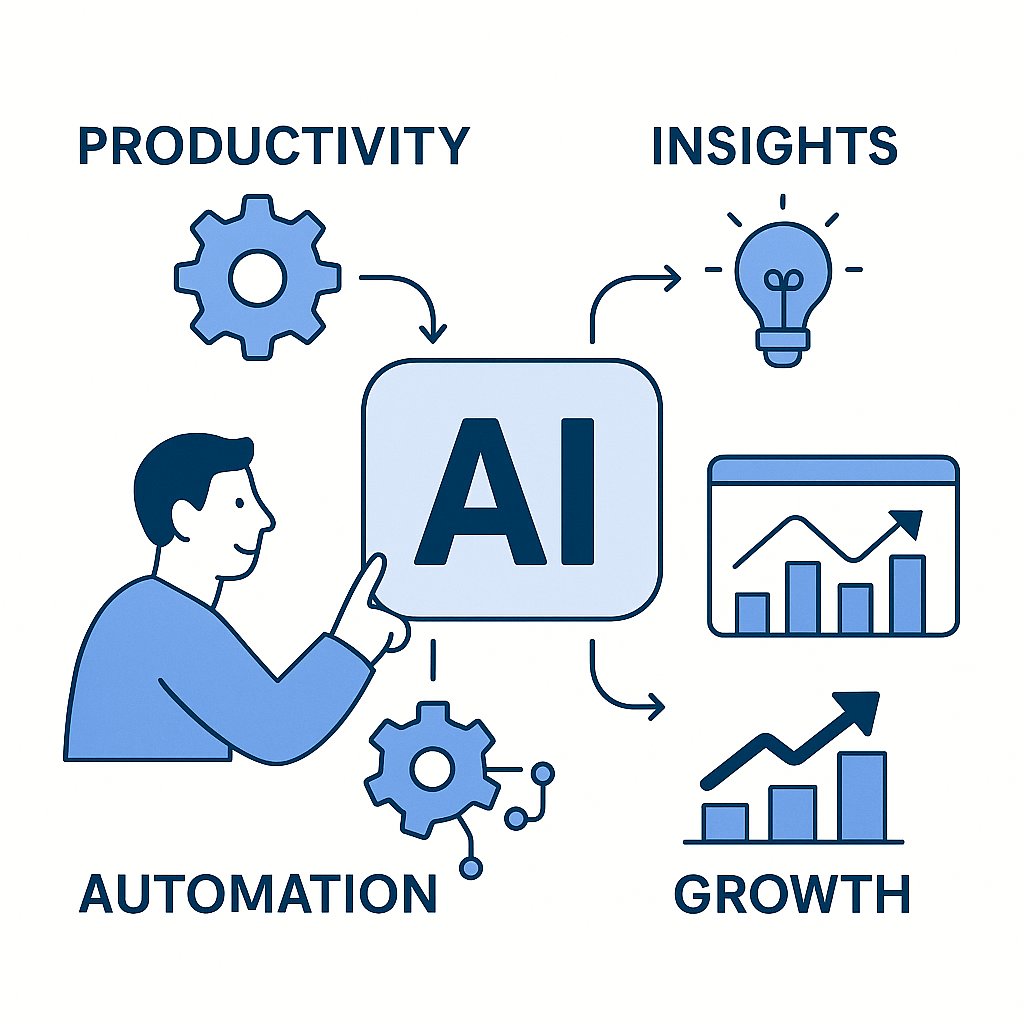
One challenge businesses face is confusing activity with impact.
Introducing an AI tool across a department may improve how quickly employees complete certain tasks. But unless that productivity translates into measurable business value, the financial case remains incomplete.
The relevant measures will depend on the business and the application.
Businesses could assess AI investment against:
-
- Revenue: Has it increased sales, conversion, or new revenue opportunities?
- Costs: Has it reduced operating or processing costs?
- Productivity: Has it reduced the time required to complete key processes?
- Capacity: Can the business handle greater volumes without proportionately increasing costs?
- Customer value: Has it improved retention, service quality, or response times?
- Decision-making: Has it improved forecasting, pricing, risk management, or resource allocation?
The objective is to move from “We implemented AI” to “Here is what the investment changed.”
The Business Case Should Come First

Don’t adopt AI simply because the technology is available or competitors are using it.
Start with the business problem.
-
- Where are costs increasing?
- Which processes are inefficient?
- Where is revenue being lost?
- Which activities consume significant management or employee time?
- Where are decisions being slowed down by poor or fragmented information?
Once the problem is clear, management can determine whether AI is the appropriate solution and establish the financial and operational outcomes expected from the investment.
This distinction also creates a basis for deciding whether an AI initiative should be scaled, redesigned, or discontinued.
Financial Discipline Matters

PwC’s 2026 Global CEO Survey found that CEOs whose organizations had stronger AI foundations were three times more likely to report meaningful financial returns. These foundations include responsible AI frameworks and technology environments that support broader integration.
The implication for businesses is straightforward: AI value depends on more than the technology itself.
Data quality, business processes, governance, integration, and the ability to measure outcomes all influence whether an AI investment creates value.
For businesses, the objective should therefore not be AI adoption for its own sake; it should be measurable business improvement.
As AI investment continues to grow, businesses need to evaluate it with the same financial discipline applied to other significant investments: understand the cost, define the expected return, measure the outcome, and determine whether the value created justifies further investment.
The question is no longer simply what AI can do for a business. It is what the investment is actually improving and whether the business can measure that improvement.